
Destination or Hotel
Departure airport
Travel dates
Nights
Guests
Destination or Hotel
Departure airport
Travel dates
Nights
Guests
Not sure where to stay in Marseille?
Chat with our destination guide for travel tips and FAQs.
Marseille, France's oldest city, is a melting pot of cultures, world-class seafood and jaw-dropping coastal scenery. From the buzzing Old Port to the dramatic limestone cliffs of the Calanques, this is a city break with character.
☀️ Good to Know for your Marseille Holiday
☀️ Weather: Marseille gets over 300 days of sunshine a year. Summers are hot at 28-30°C, and even winter stays mild at 7-12°C. The mistral wind can blow through any time of year though, so pack a light layer just in case
💶 Money: Pricier than rural Provence but still good value for a major French city. A pint costs around €5-6, a solid restaurant meal €15-25, and an espresso at the bar about €2. Bouillabaisse (the local signature dish) at a proper restaurant will set you back €40-60 for the real deal
⚽ Fun Fact: Marseille lives and breathes football. Olympique de Marseille play at the Stade Velodrome, which holds 67,000 and creates one of the most intense atmospheres in European football
🌟 Highlights of Your Holidays to Marseille 2026/2027
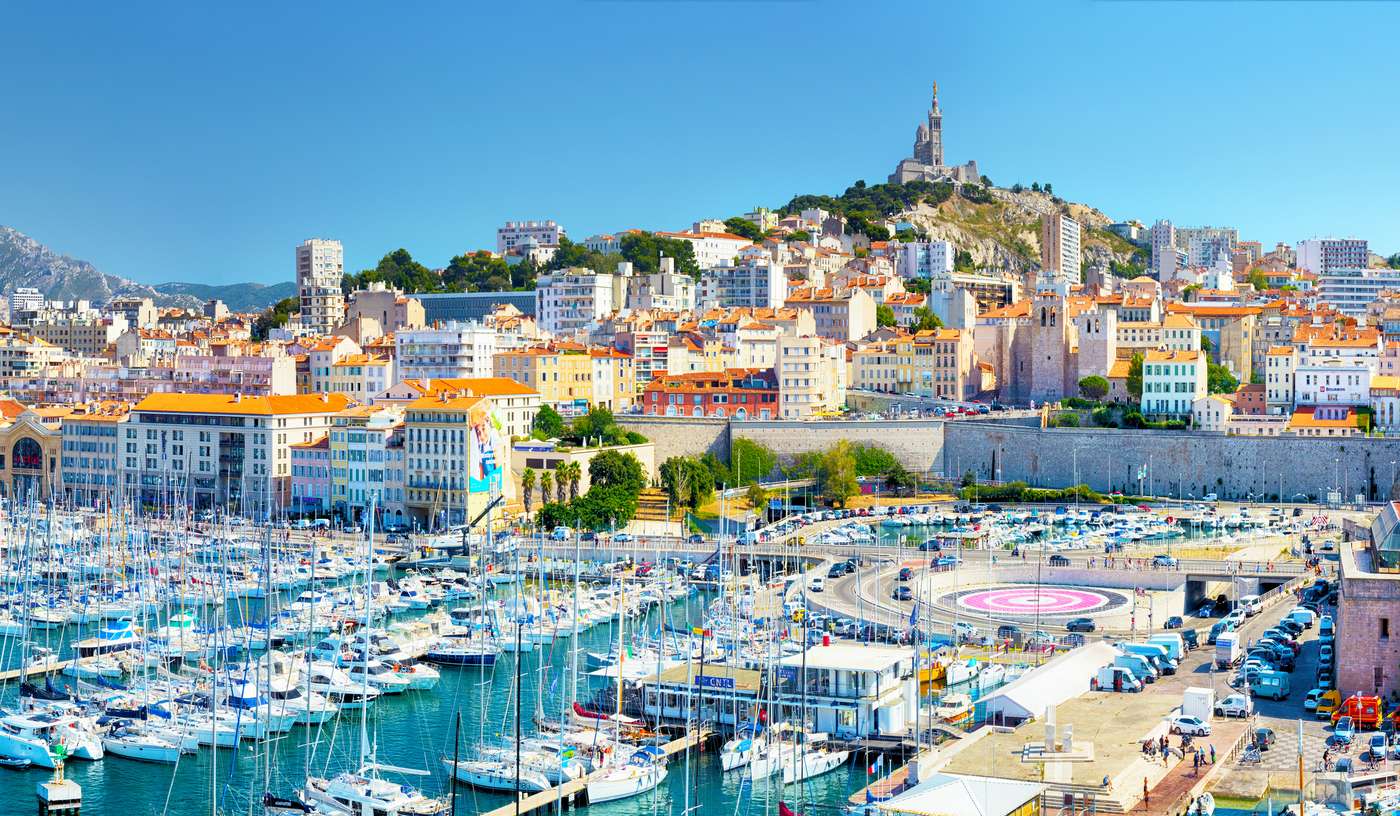
The Vieux-Port is the beating heart of the city. Cafes, seafood restaurants and fishing boats line the quays, and the daily fish market on the Quai des Belges is still a working one, not a re-enactment. Marseille has centred itself here for over 2,600 years.
Calanques National Park starts at the edge of the city. White limestone cliffs drop into turquoise water across 27 coves and more than 20km of coast, reachable by boat, kayak or on foot. It is the only peri-urban national park in Europe that is land and sea at once.
Basilique Notre-Dame de la Garde sits on a limestone outcrop 162m above the centre, and the view takes in the whole city, the coast and the islands. Locals call it la Bonne Mere, the Good Mother.
MuCEM, the Museum of European and Mediterranean Civilisations, is a striking lattice-clad building joined to the 17th-century Fort Saint-Jean by a high footbridge. The exhibitions are world class and the walk across is worth it on its own.
Le Panier is the oldest neighbourhood in France's oldest city. Narrow streets, street art, independent boutiques and artisan workshops stacked up the hillside above the port, and the kind of place you can lose an hour in without meaning to.
Marseille is perfect for you if...
You want a city break where the best park in the city is amazing limestone cliffs where you can walk down and swim in the sea
You like your seafood fresh, and in a delicious stew
You like a town with a bit of grit and character
You want a holiday in the Mediterranean, but you also only want to be on a plane for two hours
You are the sort who plans a holiday around a boat trip, a market and a very long lunch
Looking specifically for hotels in the city centre? Check out our Marseille City page for stays right in the heart of the action around the Vieux-Port, Le Panier and La Canebiere.
🏨 Top Marseille Hotels
Looking for the perfect place to stay on your Marseille holiday? You can see all our hotels in Marseille here, or browse our top picks below. For stays specifically in the city centre, also check our Marseille City page.
👨👩👧👦 What are the best family hotels for a Marseille holiday?
Radisson Blu Marseille Vieux Port is the big, well-equipped one, with an outdoor pool, a hot tub and a poolside snack bar, six minutes on foot from the Vieux-Port and with wheelchair-friendly rooms.
Residhome Marseille has kitchenettes, which changes the maths on a week away with children, plus free cots and a twelve-minute walk to the Old Port.
Residhotel Le Grand Prado is an aparthotel with a private breakfast terrace, and the pick if you want to be down at the southern end of the city rather than in the middle of it.
💑 What are the best hotels for couples on a Marseille city break?
Maisons du Monde Hotel & Suites Marseille is a design hotel by the Old Port and the Opera, with modern interiors, a concierge and the best restaurants in the city on the doorstep.
New Hotel of Marseille Vieux Port has an outdoor pool, a bar and a restaurant, and sits a short walk from the Vieux-Port, Plage des Catalans and the Corniche.
Residence du Vieux Port puts you on the harbour with a balcony and a retro fit-out, and the port view is the whole point of it.
Hotel C2 is a small five-star in a 19th-century townhouse a couple of streets back from the port, with a spa and, unusually, guest access to its own private island a few minutes out in the bay.
✨ What are the best luxury hotels for a Marseille holiday?
Sofitel Marseille Vieux-Port looks straight down the Old Port, with a spa and Turkish bath and the Dantes Skylounge bar upstairs for the sunset.
InterContinental Marseille Hotel Dieu occupies the 18th-century Hotel-Dieu on the hill in Le Panier, with a Clarins spa, an indoor pool and a terrace looking straight over the Vieux-Port to Notre-Dame de la Garde.
NH Collection Marseille is sleek and modern near the Old Port and the MuCEM, with a gym, a restaurant doing local and international cooking and excellent transport links.
🎉 What are the best hotels in Marseille for groups?
Novotel Suites Marseille Centre Euromed has roomy suites with balconies and sea views, a fitness room, a bar and a sun terrace, fifteen minutes on foot from the MuCEM and Fort Saint-Jean.
Odalys City Marseille Centre Euromed is studios and apartments sleeping up to four, with an indoor pool, sauna and Turkish bath. A solid group base with self-catering built in.
Mama Shelter Marseille is the quirky, loud one, and the right call if the group wants somewhere with its own atmosphere rather than a quiet lobby.
💰 What are the best cheap hotels for a Marseille city break?
B&B Hotel Marseille Centre Vieux Port is compact and no-fuss right in the centre, air-conditioned, with a bar and a 24-hour reception, a short walk from the Old Port, Le Panier and the MuCEM.
Escale Oceania Vieux Port sits on La Canebiere opposite the Old Port, with a proper breakfast buffet and the bus and metro stop about ten metres from the door.
Belle-Vue has a sun terrace and a games room, and does the job if you want the money going on dinner rather than the room.
Beaches in Marseille
Marseille has 57km of coastline inside the city limits, and the beaches change character completely as you go south. The central ones are small and reachable on foot or a short bus ride, the Prado strip is a big man-made park, and beyond that the coast breaks up into the calanques. All of them are free.
Plage des Catalans is the closest beach to the Vieux-Port, about fifteen minutes on foot, and one of the few in the city that is genuinely fine sand. It is small, so numbers are capped on the busiest summer days. A promenade and access upgrade is under way, with the city committing to keep the beach open through the summers.
Plage du Prophete is a small natural sand beach on the Corniche with shallow water, which makes it the pick for younger children. Bus 83 from the Vieux-Port drops you at the door, and it is lifeguarded from the start of June to the end of August. It is one of the few beaches here with proper accessible access.
The Prado beaches are a 3.5km seafront park built in the 1970s on land reclaimed from the sea using spoil from digging the metro. Worth knowing before you go: most of it is fine gravel rather than soft sand, so bring something to lie on. Bus 19 or 83 gets you there. Plage de l'Huveaune, at the southern end of the park, is closed to swimming for the whole of the 2026 season on water-quality grounds, and the other beaches in the park are unaffected.
Plage de la Pointe Rouge is the largest natural sandy beach in Marseille and the best of the city beaches for a full day. The nicest way to arrive is the RTM maritime shuttle from the Vieux-Port, which takes about half an hour and runs from late April to the end of September.
Calanque de Sormiou is the biggest of the calanques and one of the very few with a proper sand beach at the bottom. Bus 22 to Les Baumettes then about an hour on foot. The road down is closed to cars from 07:00 to 19:00 every day from 12 June to 30 August, and at weekends until 27 September, so plan on walking or taking the bus.
Calanque de Sugiton is shingle and flat rock ledges, and the swimming is as good as anywhere on this coast. A free booking is compulsory in high summer, and this is the one that catches people out: the window opens only three days ahead at 09:00 and closes at 18:00 the day before, so you cannot sort it weeks in advance. Bus B1 or 21JET to Luminy, then about an hour's walk.
The Frioul islands are a half-hour ferry from the Quai des Belges and feel a world away from the city. Plage Saint-Esteve is the main beach, sand and pebble, lifeguarded through the summer, and the coves around it are quiet even in August.
One thing worth knowing about the sea. When the mistral blows hard it pushes the warm surface water offshore and colder water rises to replace it, and the sea temperature at Marseille can drop by several degrees in a couple of days. It comes back up just as fast.
🏛️ Must See in Marseille 2026/2027
Calanques National Park. Sormiou and En-Vau are the showstoppers. Two things to plan around: Sugiton and Pierres Tombees need a free advance booking in high summer, released only three days ahead, and the roads down to Sormiou, Morgiou and Callelongue shut to cars in the middle of the day through the summer. On high fire-risk days the whole massif closes on land, though boats still run.
Chateau d'If. About twenty minutes by boat from the Quai des Belges to the island fortress of The Count of Monte Cristo. The boat and the monument are two separate tickets, the crossing is weather-dependent, and the fortress shuts on Mondays outside the summer season. Book the boat ahead in July and August, because the quayside queue is long.
MuCEM and Fort Saint-Jean. Open every day except Tuesday. You do not need to book ahead as an individual. The footbridge between the museum and the 17th-century fort is the bit people remember. The lift on the Fort Saint-Jean side is currently out of service.
Le Panier. Best done in the morning before the day-trippers. La Vieille Charite at the top of the hill is open daily except Monday and its permanent collections are free.
Notre-Dame de la Garde. Bus 60 from the Vieux-Port saves you the climb. The interior is covered in ex-voto offerings left by grateful sailors. The panoramic terrace visit has reopened as a guided tour capped at fifteen people, so it needs arranging on the day.
🏘️ Where to Stay on Your Marseille Holidays
Vieux-Port and La Canebiere. The centre of everything. Restaurants, cafes, the fish market and the transport links all on your doorstep, and where most first-timers should base themselves.
Le Panier. The old town climbing the hill above the port. Cobbled streets, street art and independent shops. Full of character, though the steep lanes are not much fun with a heavy case.
Euromed and Joliette. The regenerated waterfront near Les Terrasses du Port and the MuCEM. Newer hotels, better value, and the metro takes you everywhere else.
La Corniche. The clifftop road running south from the centre, with sea views, quieter hotels and Plage des Catalans and Plage du Prophete both within reach on foot or on bus 83.
Prado and the south. Further along the coast towards the Calanques. This is where the big beach park is, and it is calmer than the centre without being cut off from it.
🗣️ Local Lingo
Bonjour (bon-ZHOOR) Hello, and say it before anything else every time you walk into a shop. Switch to bonsoir (bon-SWAR) once the evening is in.
S'il vous plait / Merci (seel-voo-PLAY / mair-SEE) Please / Thank you
Une pression, s'il vous plait (oon press-YON) A draught beer, please
L'addition, s'il vous plait (lah-dee-see-ON) The bill, please
Sante (san-TAY) Cheers
Une bouillabaisse (BOO-yah-BESS) The city's saffron and seafood stew, and the one dish you should not leave without
Degun (day-GUN) Nobody. The city's unofficial motto is on craint degun, we fear nobody, and you will see it on half the shop windows
Fada (fah-DAH) Mad, in the affectionate sense
Peuchere (puh-SHAIR) Oh, bless him. An expression of sympathy, and about as Provencal as a word gets
Marseille Holidays 2026/2027 Travel Guide
👨👩👧👦 What are the best things to do on a Marseille family holiday?
A boat trip to Chateau d'If is the easy win. The crossing from the Quai des Belges is half the fun, and the island fortress from The Count of Monte Cristo keeps children busy with cells, ramparts and the view back at the city.
Plage du Prophete is the pick for younger ones, small and shallow with lifeguards through the summer and bus 83 dropping you at the door. Older children will get more out of the Prado park, which is a big open seafront rather than a soft-sand beach, so take something to sit on.
The MuCEM has interactive exhibits that work for older children, and the walk across the footbridge to Fort Saint-Jean is a hit at any age. The park around the fort is a good spot to let everyone run about.
A day out at La Barben, under an hour inland, combines a zoo with a drive through the Provencal countryside. Check the opening times before you set off.
💑 What are the best things to do for couples on a Marseille city break?
Walk the Corniche as the sun goes down. Five kilometres of clifftop road between the Vieux-Port and Prado, with the Frioul islands out on the water and the fishing cove at Vallon des Auffes to stop at halfway.
Take the train out to Cassis, about twenty minutes each way, for vineyards, a pretty harbour and the boats into the calanques. The station sits a few kilometres above the village, so pick up the shuttle bus at the door. The local whites and roses barely leave the region, which makes this the place to try them.
Lose an afternoon in Le Panier. The winding streets reward going slowly, and the independent cafes and galleries give you the excuses to stop.
Book a waterfront table on the Vieux-Port for the evening. Fresh seafood, the boats coming in and the city lit up around you is Marseille doing what it does best.
🎉 What are the top things to do for groups on a Marseille holiday?
Catch an Olympique de Marseille match at the Stade Velodrome. Sixty-seven thousand people and one of the most committed fan cultures in Europe. Worth doing even if football is not your thing.
Hire kayaks and paddle into the calanques. Several operators run guided group trips out of Pointe-Rouge, and getting into the coves from the water is the best way to see them.
Head for Cours Julien for the bars and live music. The artsy quarter above the centre has a completely different energy to the port, all street art, record shops and small venues packed into a few streets.
Do a pastis tasting. The aniseed spirit was first sold here in the 1930s and it is still the local ritual, poured short and topped up with cold water.
More Destinations
Fancy going further? France has plenty more, and the rest of Europe is on the doorstep.
Nice is the Riviera at full volume. The Promenade des Anglais, an Old Town built for wandering and markets worth setting an alarm for.
Paris needs no pitch. The Eiffel Tower, the Louvre, Montmartre and food that lives up to every bit of the reputation.
Cote d'Azur covers Cannes, Saint-Tropez and Antibes. Glamorous beaches, harbours full of yachts and the Mediterranean at its most polished.
Biarritz is France's surf capital on the Atlantic Basque coast. Long golden beaches, Belle Epoque grandeur and some of the best food in the country.
Nantes is a creative, walkable city on the Loire, with giant mechanical elephants, a castle with a moat and a serious eating scene.
La Rochelle is an Atlantic port town with golden beaches, one of Europe's biggest aquariums and seafood straight off the boats.
Milan is Italy's design capital. World-class art, the Duomo and the best aperitivo hour anywhere.
Rome is the Eternal City. The Colosseum, the Vatican, the Trevi Fountain and street food worth queueing for.
Geneva is lakeside elegance. The Jet d'Eau, Swiss chocolate, Alpine views and a city that runs on time.
Zurich is Switzerland at its most cosmopolitan, with an old town, a lake and world-class museums.
Germany puts Berlin, Munich and Hamburg within easy reach, with great beer and brilliant culture in all three.
Popular Marseille hotels
More Marseille hotelsWeather in Marseille
JAN
FEB
MAR
APR
MAY
JUN
JUL
AUG
SEP
OCT
NOV
DEC
Marseille runs a proper Mediterranean year. July and August average highs of around 30C and are effectively dry, with July the driest month of the whole year. June and September both sit in the mid to high twenties and are the best months to come: warm enough for the beaches and the calanques, without the heat that closes the massif on fire-risk days. May and October are comfortable for walking and sightseeing rather than swimming.
Winter is mild rather than warm, with January afternoons around 12C and plenty of clear days. That is the mistral's doing: the wind is cold and strong, and it also scours the sky, which is why Marseille racks up nearly 2,900 hours of sunshine a year.
The sea warms more slowly than the air. It peaks at about 22C in August, sits close to that through July and September, and is comfortable from June to early October. Bear in mind that a hard mistral pushes the warm surface water out and pulls cold water up, so the sea can drop several degrees in a couple of days and then recover just as quickly.
The rain, when it comes, arrives in autumn. September is the wettest month, but it falls as short heavy bursts rather than grey all-day drizzle, and it rarely costs you a whole day.
View destination on a map
View destination on a map
FAQs
Do I need a visa to visit Marseille?
Do I need a visa to visit Marseille?
The answer differs slightly across the UK & Ireland. Irish citizens have free movement in France, so a valid passport or passport card is all you need and there is no time limit on the stay.
For a United Kingdom passport you do not need a visa either, but there are three conditions. You get 90 days in any 180 across the Schengen area. Your passport must have been issued less than ten years before you arrive, and be valid for at least three months after you leave. And since April 2026 the EU's Entry/Exit System has been running at all Schengen borders, so on arrival you give a fingerprint and a photo instead of getting a stamp. It is free, it takes a couple of minutes, and the record lasts three years, so it is a one-off for most people.
What currency do they use in Marseille?
What currency do they use in Marseille?
The euro. Cards are taken almost everywhere, though a few of the older market stalls and small cafes in Le Panier and Noailles still prefer cash.
France also charges a tourist tax, paid at the hotel rather than in your booking. In Marseille it runs from about €1.09 a person a night at the budget end to €5.76 at the very top, with most three and four-star hotels landing between €2.16 and €3.25. Under-18s are exempt, so it is a smaller line on a family bill than it looks.
When's the best time to visit Marseille?
When's the best time to visit Marseille?
May, June and September are the sweet spot. Warm enough (22-28°C) for beaches and the Calanques without the intense July-August heat when it regularly tops 30°C and access to the Calanques can be restricted on fire-risk days. Spring is gorgeous for sightseeing and the city is less crowded.
What should I eat in Marseille?
What should I eat in Marseille?
Bouillabaisse, obviously. A charter drawn up by eleven Marseille restaurateurs in 1980 sets out what the real thing is: rascasse, conger eel and red gurnard at a minimum, saffron, fennel and orange peel, with the broth served first alongside garlicky rouille and croutons, and the fish brought out separately. It takes hours to make, so most places want a day's notice and serve it for two.
Beyond that, try panisse, the chickpea fries you get at every market, and navettes, the orange blossom biscuits a bakery on the rue Sainte has been making since 1781. Pastis is the drink, poured short and topped with cold water. The Marche des Capucins in Noailles is the morning market to head for, with olives, cheese, spices and North African cooking all in a couple of streets.
Is Marseille expensive?
Is Marseille expensive?
Cheaper than Paris and Nice, pricier than rural Provence, and easy to control. A beer runs about €5.60 to €6, a restaurant main €18 to €25, and bouillabaisse at a proper place is the splurge at €45 to €75 a head, which buys you the full ceremony.
Public transport is a bargain. A single is €1.70 from the app or a machine, a 24-hour pass is €5.20, and under-11s travel free across the whole network. The beaches are free, the ferry across the Old Port costs small change, and the permanent collections at several of the museums cost nothing.
What are the best beaches in Marseille?
What are the best beaches in Marseille?
Plage des Catalans is the closest, about fifteen minutes on foot from the Vieux-Port and one of the few in the city that is real sand. Plage du Prophete on the Corniche is small and shallow and the best of them for young children. Plage de la Pointe Rouge is the biggest natural sandy beach in the city and the nicest to reach, by maritime shuttle from the Old Port.
The Prado beaches are the long seafront strip everyone means by "Marseille beach", and they are worth knowing about in advance: the whole park was built in the 1970s on reclaimed land and most of it is fine gravel rather than soft sand.
For the postcard version you want the calanques. Sormiou has a sand beach at the bottom, Sugiton is shingle and rock ledges with the clearest water of the lot, and both take about an hour on foot from the nearest bus stop.