
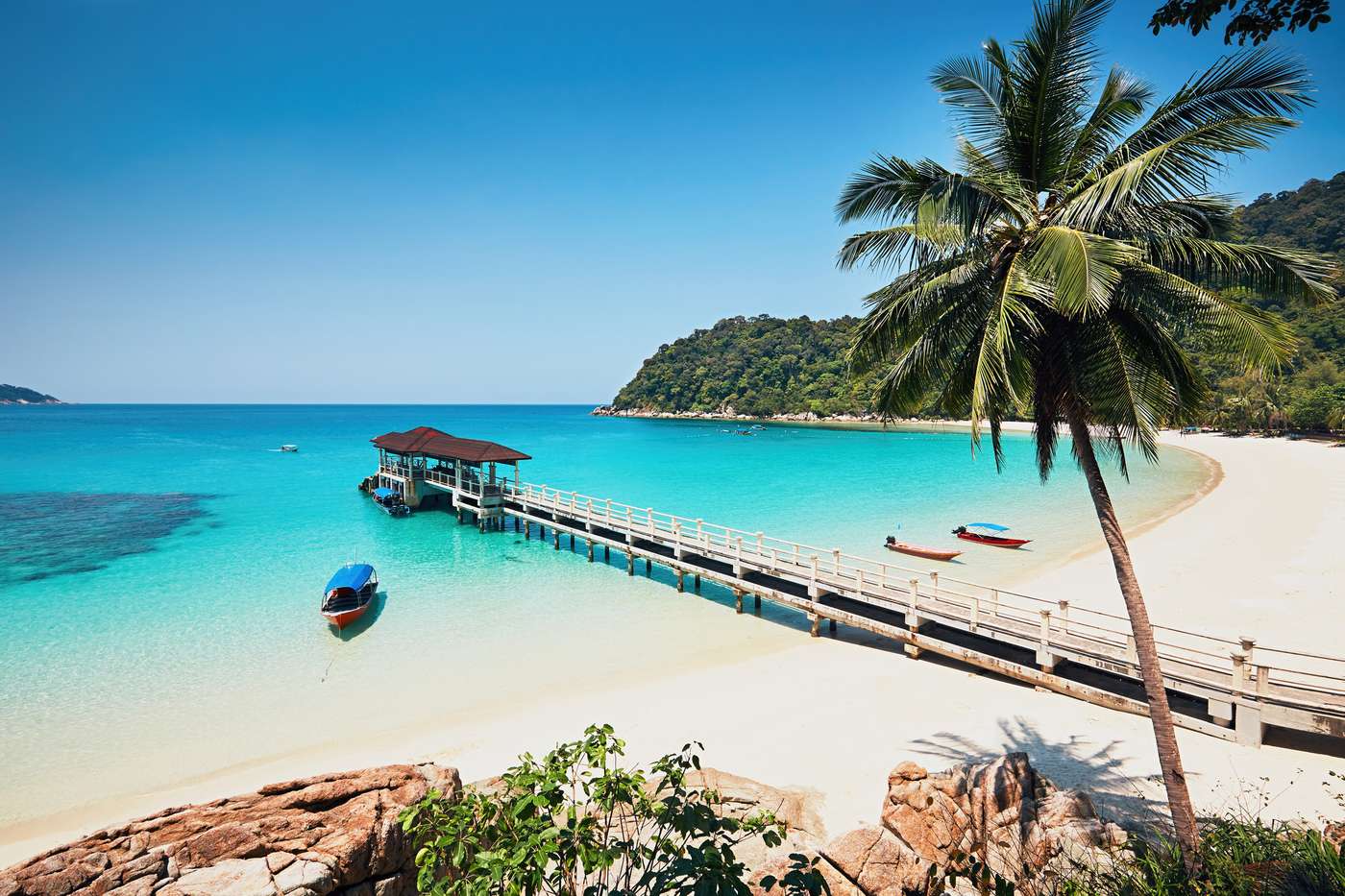
Malaysia is three holidays in one country: a modern skyline city that never stops eating, rainforest islands with sand like caster sugar, and a beautiful historic town where the street food has its own fan clubs.
Highlights of your Holiday to Malaysia 2026 / 2027
A skyline that earns the photo - Kuala Lumpur has the Petronas Twin Towers, and now Merdeka 118, which at 678.9m is the second-tallest building on the planet with an observation deck near the top.
Islands with rainforest running down to the sand - Langkawi is an archipelago of ninety-nine islands where the jungle comes right to the beach, hornbills sit in the hotel trees, and a cable car hauls you up to a curved sky bridge slung between two peaks.
The best street food in Asia - Penang's hawker centres are the reason people fly here. Char kway teow, assam laksa, char siu, cendol, all cooked by people who have made one dish and only that dish for thirty years.
A UNESCO heritage town you can walk end to end - George Town's shophouses, clan jetties and wall murals are all within a morning's wander, and the whole place is listed.
Three cultures, one country, and every festival going - Malay, Chinese and Indian traditions run side by side, which is why the calendar has Chinese New Year, Hari Raya, Deepavali and Thaipusam all in the same twelve months.
✨ Good to Know for your Malaysia Holiday
☀️ Weather - Hot and humid every single day of the year, 30°C to 33°C with barely a degree between January and July. Rain comes in short heavy bursts rather than grey afternoons, usually late in the day, and it is over before you have finished your drink.
💰 Money - A plate of the best food you will eat all year costs £2-£4 / €2-€4 at a hawker centre. A restaurant main is £5-£9 / €6-€10, a teh tarik is under £1 / €1, and a local beer is £3-£4 / €3-€5, which is the one thing here that is not a bargain.
🏛 Fun Fact - Malaysia is home to the second-tallest building in the world. Merdeka 118 tops out at 678.9m, which is tall enough that the observation deck sits above the cloud layer on a wet morning and you look down on the weather.
Malaysia is perfect for you if...
You want to visit Asia but you also like the idea of English being spoken pretty much everywhere
You would genuinely pick a holiday based on what is for lunch (this is the country that invented the argument about whose laksa is best, and it has been running for a century)
You want a long-haul trip your money goes embarrassingly far, without downgrading the standard of hotels
You want a combination of a big, modern, metropolis (with the worlds 2nd tallest building), some amazing beaches, incredible lush forests and historic cities which are utterly unlike anything back home
🗣️ Local Lingo - Talk Like a Local
You genuinely do not need any Bahasa Malaysia here, because English is everywhere and most people you meet will be switching between three languages before lunch. But, we'd still say it's worth having a go anyway. The reaction you get for trying is worth the five minutes it takes to learn a couple of these.
Apa khabar?, AH-pah KAH-bar, How are you? (the everyday hello)
Selamat pagi, seh-LAH-mat PAH-gee, Good morning
Terima kasih, teh-REE-mah KAH-seh, Thank you
Sama-sama, SAH-mah SAH-mah, You're welcome
Berapa harga?, beh-RAH-pah HAR-gah, How much is it?
Sedap!, seh-DAHP, Delicious! (deploy at every hawker stall)
Boleh, BO-leh, Can do / no problem (you will hear this roughly four hundred times a day)
Tandas, TAN-dass, Toilet
Jumpa lagi, JOOM-pah LAH-gee, See you again
Where to Stay
Malaysia splits neatly into three holidays and the hard part is picking one, because the country is genuinely good at all of them. The short version: the capital for a city break with the best food scene in Asia attached, Langkawi for rainforest-backed beaches and duty-free everything, Penang for the combination of heritage streets and a proper beach strip. All three have their own airport, so you land where you are staying.
Kuala Lumpur is best for a first trip and for anyone who wants everything on the doorstep. Bukit Bintang for shopping and street food, KLCC for the towers and the park, Bangsar for the restaurant scene locals actually book.
Langkawi is best for a beach week with a bit of adventure in it. Duty-free island, ninety-nine islands to boat between, and hotels that sit between jungle and sand.
Pantai Cenang is the busiest and most sociable stretch of Langkawi, with the bars, the beach restaurants and the watersports operators all along one strip.
Penang is best if you want a holiday with a bit of substance to it. World-class food, a UNESCO-listed town, colonial architecture, and a beach strip at Batu Ferringhi twenty minutes up the coast.
Penang Island covers the beach side of the equation, with the big resorts strung along Batu Ferringhi and the national park at the far end.
Our Favourite Hotels in Malaysia
👨👩👧👦 What are the best family hotels in Malaysia?
Berjaya Langkawi is a proper rainforest resort with its own private beach, chalets on stilts over the water and in among the trees, a kids' club, a playground and enough sport to fill a fortnight. Monkeys and hornbills turn up in the grounds uninvited, which for most kids is the entire holiday sorted.
PARKROYAL Penang Resort sits right on Batu Ferringhi with a big free-form pool, a kids' club and the beach directly out front. The night market is a walk away, which solves dinner every evening of the trip.
Golden Sands Resort Penang is the family workhorse of the Batu Ferringhi strip, built around gardens and pools with a supervised kids' programme and direct sand access.
Berjaya Times Square Hotel, Kuala Lumpur has an indoor theme park with a rollercoaster in the shopping centre it sits on top of. On the one wet afternoon you get, this hotel wins the holiday.
💑 What are the best hotels in Malaysia for couples?
Casa del Mar Langkawi is a low-slung Mediterranean-style boutique right on Pantai Cenang, close enough to the beach that you can hear it from bed and far enough down the strip to miss the noise.
Eastern and Oriental Hotel Penang has been going since 1885 and looks it in all the right ways: marble, palms, sea-facing lawn, and a bar that has served most of the twentieth century's more interesting travellers.
Banyan Tree Kuala Lumpur is all suites, all high up, with a rooftop bar that looks straight at the Petronas Twin Towers and one of the best spas in the city downstairs. Consistently one of the best-reviewed hotels in Kuala Lumpur.
✨ What are the best luxury hotels in Malaysia?
The Datai Langkawi is built into a ten-million-year-old rainforest above its own bay on the quiet north of the island, with villas among the canopy and a resident naturalist to explain what just walked past your terrace. One of the best-reviewed resorts in the whole country.
Shangri-La Rasa Sayang, Penang sits in thirty acres of gardens on Batu Ferringhi with water slides for the kids, a serious spa for you, and the sort of service that makes people rebook before they check out.
The Westin Langkawi Resort & Spa has a headland position with the Andaman Sea on three sides, tiered pools running down to the water and sunsets that do most of the work.
🎉 What are the best hotels in Malaysia for groups?
MiCasa All Suites Hotel Kuala Lumpur is an all-suite property with kitchens, gardens and a tennis court, which means everyone gets their own space and somebody can be trusted with breakfast.
Holiday Villa Resort & Beachclub Langkawi puts you on the sand at Pantai Cenang with the bars, the beach restaurants and the jet ski operators all in one direction.
DoubleTree Resort by Hilton Penang has family and connecting rooms that work just as well for a group, a beachfront position and a bar that runs late by Batu Ferringhi standards.
What are the top Beaches in Malaysia?
Pantai Cenang, Langkawi - The island's main event and its most sociable stretch: two kilometres of pale sand with parasailing and jet skis at one end, beach bars at the other, and the sun going down over the Andaman Sea in between. Duty-free island, so a sunset drink here costs what a coffee costs at home.
Tanjung Rhu, Langkawi - The quiet counterpoint on the north coast, backed by limestone cliffs and mangroves, with almost nothing built on it. Wade out at low tide toward the offshore stacks and you will have the place largely to yourself.
Datai Bay, Langkawi - Repeatedly named among the best beaches in the world, and one of the few anywhere where ancient rainforest runs straight down to the sand. Calm, sheltered water and hornbills overhead.
Batu Ferringhi, Penang - The island's resort strip, a long curve of sand with the big hotels behind it and a night market that takes over the road after dark. Parasailing and banana boats by day, satay and haggling by night.
Monkey Beach, Penang - Inside Penang National Park at the end of a jungle trail, or a short boat ride if you would rather not sweat for it. Macaques on the sand, a couple of shacks selling grilled fish, and a lighthouse walk up the headland.
Cheap holidays to Malaysia
Malaysia is one of those long-haul destinations where the flight is the expensive bit and everything after it is not. Once you land, the daily cost of a holiday here is closer to a week in Turkey than a week in the Caribbean, and that is before you have worked out that the food you will remember for years is the food that costs the least.
The single biggest saving is board basis, and it is also the best decision you can make for the holiday itself. Book room-only or bed and breakfast and eat out. A plate at a hawker centre runs £2-£4 / €2-€4, a sit-down restaurant main is £5-£9 / €6-€10, and the hawker plate is very often the better meal. Penang in particular has stalls that have been perfecting a single dish since the 1970s. Paying a hotel to feed you here is the one genuinely poor-value move available.
Beyond that: get the Grab app before you fly, because a cross-city ride in Kuala Lumpur costs less than a bus fare at home, and the MRT and monorail cover most of what you will want to see. Drinking is the exception to everything above, with a local beer at £3-£4 / €3-€5, so if a sundowner matters to your holiday, Langkawi is duty-free and priced accordingly. A lot of the best days out cost nothing at all: George Town's murals and clan jetties, the Batu Caves stairs, the KLCC park fountains, and the beaches themselves are all free so a cheap, but brilliant, Malaysia holiday is definitely doable.
Malaysia Holidays 2026/2027 - Travel Guide
👨👩👧👦 What are the best things to do on a Malaysia family holiday?
Aquaria KLCC, Kuala Lumpur - A 90-metre underwater tunnel with sand tiger sharks cruising over your head, right underneath the convention centre. Half a day, fully air-conditioned, and it is on the doorstep of the Petronas towers.
The Langkawi SkyCab and Sky Bridge - A cable car up Machinchang mountain to a curved pedestrian bridge slung 660m above the rainforest, with a glass floor section for anyone in the family who needs testing.
Batu Caves, Kuala Lumpur - 272 rainbow-painted steps up to a limestone cavern with a temple inside and a 42m golden statue at the bottom. The macaques will try to take your snacks, which is either the highlight or the incident.
Penang Hill funicular - One of the steepest funicular railways anywhere, hauling you up to a ridge with the whole island laid out below, a treetop walk and considerably cooler air than you left at the bottom.
Escape Penang - A jungle theme park built into the hillside with zip lines, water slides and rope courses, and almost no queueing compared with anything similar at home.
💑 What are the best things to do for couples on a Malaysia holiday?
Island hopping around Langkawi - Boats out to the ninety-nine islands, stopping at the freshwater Lake of the Pregnant Maiden, an eagle-feeding spot and a beach you get to yourselves for an hour.
The Kilim Geoforest Park mangroves - A slow boat through limestone karsts and mangrove tunnels on Langkawi's east coast, with brahminy kites overhead and bat caves to duck into. Go late afternoon when the light does something ridiculous.
Rooftop bars in Kuala Lumpur - The city has more of them than it strictly needs, all pointed at the same illuminated towers, and the drinks cost a fraction of what the view would command anywhere else.
George Town on foot - Shophouses, clan jetties built out over the water, the Blue Mansion, and Ernest Zacharevic's wall murals hidden down side streets. Do it early before the heat arrives.
Sunset at Tanjung Rhu - Langkawi's quietest good beach, backed by limestone cliffs, with the sun dropping behind the offshore stacks and almost nobody else there to see it.
🎉 What are the top things to do for groups on a Malaysia holiday?
Jalan Alor night market, Kuala Lumpur - A whole street of open-air stalls and plastic chairs where the grilled seafood, satay and Hokkien mee arrive faster than you can order. The natural home of a big group and a long evening.
Batu Ferringhi night market, Penang - The resort strip's road closes and fills with stalls after dark. Haggling is expected and taken in good spirits, and the satay carts at the far end are the real reason to go.
Watersports at Pantai Cenang - Jet skis, parasailing, banana boats and paddleboards all along one stretch, with operators competing hard enough that the group rate is worth asking for.
A Langkawi sunset cruise - Catamarans out of Pantai Cenang with dinner, a swim stop and a duty-free bar, which on this island means the round is a great deal cheaper than the boat.
Bukit Bintang, Kuala Lumpur - The city's late-night quarter, with the Changkat strip of bars and restaurants running off it. Enough range that the group can disagree about dinner and everyone still eats well.
A cooking class in Penang - Most start with a market walk to buy the ingredients and end with everyone eating what they made. Competitive, funny, and you go home able to make a laksa.
🌍 Places to go in Malaysia
Kuala Lumpur
Langkawi
Penang
Perhentian Islands
Borneo
Malacca
🌏 Other Places to Explore in Southeast Asia
Popular Malaysia hotels
More Malaysia hotelsWeather in Malaysia
JAN
FEB
MAR
APR
MAY
JUN
JUL
AUG
SEP
OCT
NOV
DEC
Malaysia sits a few degrees off the equator, which means 30°C to 33°C, every month, with humidity to match. There is no cold season, no shoulder season and no month you would call a write-off. What changes is the rain, and it changes by coast.
Everything on the west side, which is Kuala Lumpur, Langkawi and Penang, runs driest from roughly December through to February and into March. The rest of the year still gets plenty of sunshine, with rain arriving as short, theatrical, late-afternoon downpours that clear the air and are done inside an hour. Locals treat them as a signal to have a coffee. The east coast runs the opposite cycle and is at its wettest from November to February.
The upshot for a beach week in Langkawi or Penang: December to March is the driest run, the summer months are hot and lively with the school holidays in full swing and every festival and night market going, and the wetter months bring greener rainforest, fuller waterfalls and less tourists but both halves of the year can be brilliant. Pick your dates around your diary, not the forecast.
Planning your trip? See month-by-month averages and find the best time to go. Malaysia weather by month
View destination on a map
View destination on a map
FAQs
How long does it take to fly to Malaysia?
How long does it take to fly to Malaysia?
Direct flights from London to Kuala Lumpur take approximately 12 hours 45 minutes to 13 hours 20 minutes, making Malaysia one of the longer long-haul destinations from the UK. All direct flights land at Kuala Lumpur International Airport (KUL), located around 50km south of the city centre. British Airways and Malaysia Airlines both operate non-stop services from London Heathrow.
Most travellers also choose connecting routes via Middle Eastern or Asian hubs, these add 2–5 hours to total journey time but can offer significantly lower fares and the option of a stopover.
Route | Flight time | Airlines |
London Heathrow to Kuala Lumpur (direct) | approx. 12h 45m–13h 20m | British Airways, Malaysia Airlines |
Via Dubai (Emirates) | approx. 15–16h total | Emirates |
Via Doha (Qatar Airways) | approx. 15–16h total | Qatar Airways |
Via Abu Dhabi (Etihad) | approx. 15–16h total | Etihad |
Via Singapore (Singapore Airlines) | approx. 16–18h total | Singapore Airlines |
Important airport note: Kuala Lumpur has two terminals, the main KLIA terminal and the separate klia2, used by budget carriers including AirAsia. Check which terminal your flight uses before you travel, as they are not within walking distance of each other.
What's the time difference between the UK and Malaysia?
What's the time difference between the UK and Malaysia?
Malaysia operates on Malaysia Standard Time (MYT, UTC+8) and does not observe daylight saving time. This means the time difference changes depending on the time of year in the UK.
Summer (late March–late October): UK on BST (UTC+1) - Malaysia is 7 hours ahead
Winter (late October–late March): UK on GMT (UTC+0) - Malaysia is 8 hours ahead
It's Malaysia that stays fixed, it's the UK shifting. Worth noting when planning calls home or booking airport transfers, as the gap between your body clock and local time can be significant on arrival. Most travellers find westbound journeys (Malaysia to UK) harder to adjust to than eastbound.
What currency do they use in Malaysia?
What currency do they use in Malaysia?
The currency of Malaysia is the Malaysian Ringgit, with the currency code MYR and symbol RM. Notes come in denominations of RM1, RM5, RM10, RM20, RM50 and RM100. Coins come in 5, 10, 20 and 50 sen denominations.
Ringgit availability: Unlike some Asian currencies, Ringgit can be purchased in the UK before travel, though availability varies. You'll generally get a better rate exchanging on arrival.
Cards: Visa and Mastercard widely accepted in hotels, shopping centres, restaurants and larger businesses in cities. Less reliable in rural areas, markets and hawker stalls.
Cash: Essential for street food, taxis, markets and smaller establishments, always carry some. Hawker centres (the open-air food courts where you'll eat some of the best meals of your trip) are typically cash only.
ATMs: Widely available throughout Kuala Lumpur and major towns. Note that Malaysian ATMs use 6-digit PINs, some travellers with 4-digit PINs have reported issues, so check with your bank before travelling.
Money changers: Licensed money changers in shopping centres typically offer better rates than bank branches or airport bureaux de change.
What language do they speak in Malaysia?
What language do they speak in Malaysia?
Bahasa Malaysia (Malay) is the official national language and is used in government, education and formal settings. However, Malaysia is one of the most linguistically diverse countries in Asia, and the practical reality for UK visitors is that English is very widely spoken, particularly in Kuala Lumpur, Penang, Langkawi and tourist areas, making it genuinely one of the more straightforward destinations in Southeast Asia for English speakers.
Beyond Malay and English, Mandarin and various Chinese dialects (Cantonese, Hokkien, Hakka) are widely spoken in Chinese communities, and Tamil is spoken across Indian communities. This multilingual character is one of Malaysia's most distinctive features and shows itself in the extraordinary fusion of cuisines, festivals and cultural influences that define the country.
Useful Malay phrases
English | Malay | Sounds like |
Hello | Helo / Hai | Heh-loh / Hi |
Thank you | Terima kasih | Teh-REE-ma KAH-see |
You're welcome | Sama-sama | Sah-mah sah-mah |
Please | Tolong / Sila | Toh-LONG / SEE-la |
How much? | Berapa harganya? | Beh-RAH-pah har-GAH-nyah |
Delicious | Sedap | Seh-DAP |
Excuse me | Maaf | Mah-AF |
Cheers | Yam seng | Yam seng |
Do I need a visa to travel to Malaysia?
Do I need a visa to travel to Malaysia?
No. Passport holders from the UK & Ireland get visa-free entry for stays of up to 90 days. Your passport needs to be valid for at least six months from the date you arrive and to have two blank pages.
The bit that catches people out is the Malaysia Digital Arrival Card, which is mandatory and entirely separate from the visa exemption. It is free, it takes a few minutes online, and it can only be submitted within three days of arrival, so it is not something to tick off the week before. You get a QR code back and show that with your passport at immigration. If you hold dual nationality, travel on the passport you used to register.
When is the best time to visit Malaysia?
When is the best time to visit Malaysia?
Malaysia has a tropical climate year-round, warm, humid and always with the possibility of rain regardless of season. The key factor is which part of the country you're visiting, because the east and west coasts experience their wet and dry seasons at opposite times of year.
West coast (Kuala Lumpur, Penang, Langkawi, Cameron Highlands)
Best: November to February, drier, slightly cooler, excellent beach weather on Langkawi and Penang
Wetter: April to October, afternoon thunderstorms are common but usually brief, and the coast remains very visitble
East coast (Perhentian Islands, Tioman, Redang)
Best: March to October, clear seas, excellent diving and snorkelling visibility, turtle nesting season
Avoid: November to February, northeast monsoon brings heavy rain, rough seas and most resorts close entirely
Kuala Lumpur specifically: June, July and August are the driest months in the capital, making this a good time for city-focused trips.
Best time by activity
Activity | Best months |
West coast beaches (Langkawi, Penang) | November–February |
East coast beaches and diving | March–October |
Borneo wildlife and jungle | March–September |
Kuala Lumpur city break | Year-round (June–August driest) |
Cameron Highlands | Year-round (cooler and greener after rain) |
Turtles (east coast) | May–September |
Key festivals worth timing your visit around:
Thaipusam at Batu Caves (January/February) is one of the most extraordinary Hindu festivals in the world.
Chinese New Year (January/February) brings spectacular street celebrations across the country.
Hari Raya Aidilfitri (dates vary with Islamic calendar) sees Malaysia at its most festive and welcoming, though note some businesses and attractions close.
What is the food like in Malaysia?
What is the food like in Malaysia?
It is the reason a lot of people come back. Three cuisines have been borrowing from each other here for centuries, so you get nasi lemak for breakfast, char kway teow from a wok that has not been washed properly since 1985 (this is the point), roti canai at any hour, and Penang assam laksa that people fly in for. Eat at hawker centres, where every stall does one dish and only that dish. Gurney Drive in Penang and Jalan Alor in Kuala Lumpur are the two everyone starts with, and neither will let you down.
Is Malaysia good for families?
Is Malaysia good for families?
Very. It is one of the easiest long-haul countries to take children to: English is spoken everywhere, the food is mild by regional standards and there is rice and noodles on every menu, healthcare is excellent, and no vaccinations are required for a standard resort or city trip. Kuala Lumpur has an aquarium, a bird park and an indoor theme park, Langkawi has the cable car and a wildlife park, and Penang has a jungle adventure park and a beach strip built around big family resorts. The one thing to plan for is the heat, so build in pool afternoons and do the walking early.
Is there a tourist tax in Malaysia?
Is there a tourist tax in Malaysia?
Yes. Malaysia charges foreign visitors a tourism tax of RM10 per room per night, which is roughly £2 / €2. It is per room rather than per person, so a family pays the same as a couple, and it is settled at the accommodation rather than included in your booking. Malaysian citizens and permanent residents are exempt.