
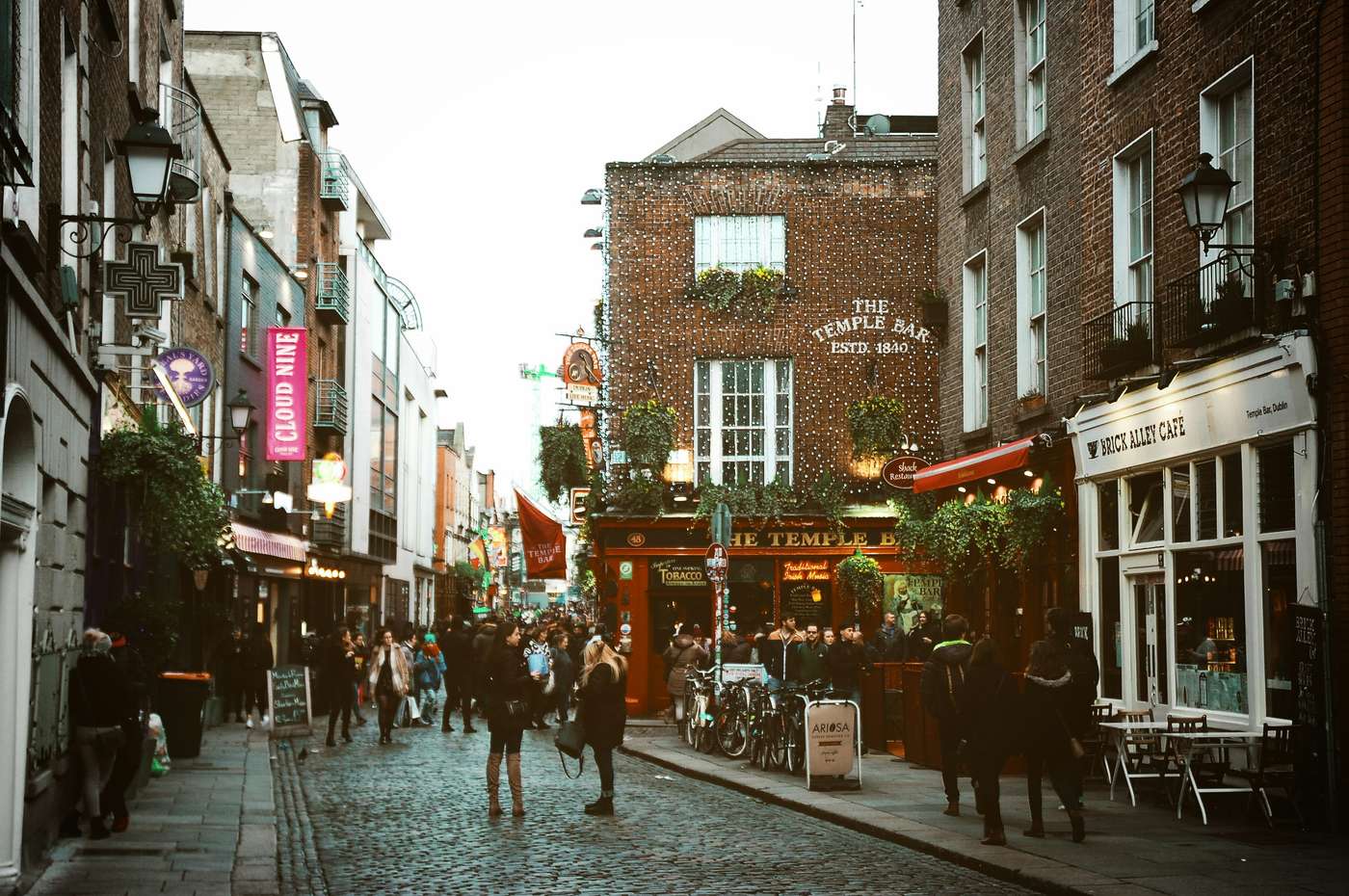
Dublin is the easiest weekend away in Europe: an hour and a half from most of the United Kingdom, small enough to cross on foot, it combines history, culture, and a VERY lively atmosphere. From its historic landmarks to some of the best pubs in the world, Dublin offers proper good 'craic' for every kind of holidaymaker.
Dublin City Break Highlights 2026 / 2027
Everything Is Walkable - The Guinness Storehouse, Trinity College, Temple Bar, the Ha'penny Bridge and St Stephen's Green sit inside about two square kilometres. You don't need a taxi all weekend.
The Pubs Are The Attraction - Honestly, the city is known for it's pubs. The Brazen Head has live music seven nights a week from nine, Porterhouse on Parliament Street does the same, and Temple Bar is legendary for a reason.
Museums That Cost Nothing - The National Gallery, the National Museum at Kildare Street, Collins Barracks, the National Library and IMMA are all brilliant and they're all free.
Guinness, Properly - The Storehouse ends with a pint in the Gravity Bar and a view over the whole city, and it is included in the ticket.
A Georgian City - Merrion Square and Fitzwilliam Square are the postcard: rows of Georgian townhouses with brightly painted doors, and Oscar Wilde's childhood home on the corner of the first one. Clutch your handbag and get your photo outside the door.
🎉 Good to Know
☀️ Weather – Dublin's mild year-round but don't expect Mediterranean sunshine. Summer temps average 15-20°C, winter around 5-8°C, and rain is always a possibility (pack a waterproof). The upside? You'll rarely get extreme heat or cold, and those grey skies make the pub even cosier.
💷 Prices – A pint in Temple Bar will set you back around €7-10 (£6-8), though you'll find cheaper in local pubs off the tourist trail. A decent meal runs €25-40 (£21-35). Also there's loads of free stuff – Phoenix Park, the National Museum, and people-watching on Grafton Street won't cost a penny.
☘️ Fun Fact – Dublin's a UNESCO City of Literature for good reason. It's produced four Nobel Prize winners (Yeats, Shaw, Beckett, Heaney), inspired Joyce's Ulysses, and Oscar Wilde grew up just off Merrion Square. You can still drink in the same pubs these literary legends frequented.
Dublin holidays, a view from our expert...
"The most memorable bits of my Dublin trip were the bits I stumbled into by accident. The Palace Bar was the place I ended up spending most of an evening, proper Victorian decor, stained glass overhead, and a noticeably more local crowd than anywhere on the main strip. I found Iveagh Gardens completely by accident, just behind St Stephen's Green, and it genuinely felt like I'd found something nobody else knew about, waterfalls and all. The food scene surprised me too, I had one of the best brunches of my life in a tiny café in Phibsborough that I'd never have found without asking a local. One tip I'd pass on: the city centre is small enough to walk everywhere, so don't waste money on taxis between the main areas, you'll see far more on foot anyway."
-Rob Brooks, OtB Holiday Expert
Dublin is perfect for you if...
You want a city break where the flight is ninety minutes and you are in a pub by six
You would rather walk everywhere than work out a metro map, because everything worth seeing is inside twenty minutes on foot
You want live music every night without buying a ticket for any of it
You like the idea of a weekend where two of the best afternoons cost nothing, because (most of) the galleries and museums are free
You have a stag, a hen or a birthday to organise and you need somewhere everyone can get to cheaply from anywhere in the United Kingdom & Ireland
🏨 Dublin Hotels
Dublin's got accommodation to suit every type of city break, from buzzy Temple Bar pads to leafy Ballsbridge retreats. Here are some top picks for your Dublin holidays:
👨👩👧👦 What are the best Dublin hotels for families?
The Spencer Hotel is a Docklands four-star with an 18-metre heated pool, a gym and a sauna, which on a wet Dublin afternoon is the whole holiday. The EPIC emigration museum is next door and the centre is a fifteen-minute walk along the river.
Staycity Dublin Castle is self-catering apartments with full kitchens, ten minutes from Temple Bar, and the flexibility over mealtimes is what makes it work with children.
Staycity Aparthotels Dublin City Centre does the same thing on the north side, with in-room kitchenettes and a café downstairs for the mornings nobody wants to cook.
Trinity City Hotel is about as central as Dublin gets, walking distance from Trinity College, Temple Bar and St Stephen's Green, with 24-hour room service for the late-night snack emergencies.
💑 What are the best Dublin hotels for couples?
Dylan Hotel Dublin is the five-star: boutique, individually designed rooms in leafy Ballsbridge, an award-winning restaurant using Irish produce, and a cocktail bar built for a slow nightcap. Grafton Street is ten minutes' walk.
The Morgan Hotel is stylish, air-conditioned and right in the middle of Temple Bar, with 10 Fleet Street downstairs doing some of the best cocktails in the city. Trinity College and the river are both a short stroll.
Radisson Blu St Helens Hotel is a period house in Ballsbridge with gardens, a library and the Talavera restaurant, and it feels like a proper escape from the city while staying on the DART line.
Wren Urban Nest is the small, design-led, sustainability-minded one on Aungier Street, a few minutes from Grafton Street, with a café and a bar and not much fuss.
🎉 What are the best Dublin hotels for groups?
Temple Bar Hotel is literally in Temple Bar, with a restaurant and a lively pub on site and Trinity College a two-minute walk. You cannot be closer to the night out than this.
Blooms Hotel is the other Temple Bar option, three minutes from Trinity College and five from Dame Street, surrounded by the pubs everyone came for.
The Grafton sits right by Grafton Street's shopping with a bar, a restaurant and a café under one roof, and it carries the highest guest rating of any Dublin hotel we sell.
Dublin One Hotel is a five-minute walk from Croke Park, which makes it the one to book for a match or a gig, and it has a restaurant and bar on site for before and after.
Where to Stay in Dublin
Dublin is compact enough that nowhere central is badly placed, so the choice is about what you want outside the door at midnight rather than how far you have to walk in the day. Everything below is inside a half-hour walk of Trinity College, and the Luas or a €2 bus covers the rest.
🎉 Where should groups stay in Dublin?
Temple Bar is the obvious one and it is loud. Cobbled lanes, live music from the afternoon, and the highest drink prices in the city. If the point of the trip is the night out, staying here means walking home rather than finding a taxi at two in the morning.
O'Connell Street and Parnell Square are the north side of the river, five minutes over the bridge, noticeably cheaper for the same standard, and handy for the Luas.
Croke Park is the one to book if you are here for a match or a concert, because you can walk back to the hotel with eighty thousand other people rather than queue for transport.
💑 Where should couples stay in Dublin?
Grafton Street and St Stephen's Green are the smart side: the good shopping, the Georgian squares, the park, and restaurants that are not competing with a sound system.
Ballsbridge is leafy, residential and about twenty-five minutes' walk or ten on the DART, and it is where the city's quietest good hotels are.
Trinity College puts you between the two, which is the most central you can be without being in the noise.
👨👩👧👦 Where should families stay in Dublin?
Dublin City Centre is the practical family choice, because the aparthotels with kitchens are here and self-catering solves breakfast and fussy eaters in one go.
Smithfield and The Liberties sit on the walk out to the Guinness Storehouse and Kilmainham, are calmer in the evening, and are a short walk from Phoenix Park and the zoo.
Ballsbridge is the quiet option that still has real choice: leafy, residential, ten minutes on the DART, and more family-sized rooms than anywhere outside the centre itself.
✈️ Where should I stay for an early flight?
Dublin Airport has hotels with shuttles, which is worth it for a dawn departure and not worth it otherwise, since the airport is only twenty to forty minutes from town. Dublin West is the cheapest area we sell in Dublin and has the most rooms outside the centre. Rathmines, Dublin North, Dublin South, Clontarf and Kilmainham all have their own pages too.
City Breaks in Dublin
Dublin is the city break that works when nothing else does. The flight is about ninety minutes from most of the United Kingdom, there is no visa and no border queue, the euro is the only thing to sort out, and you can be out of the airport and drinking in the centre inside an hour. It is the shortest distance between a Friday afternoon and a proper night out that Europe offers.
Two nights is the right length, and three is better. The centre is small: the Guinness Storehouse to Trinity College is a twenty-five minute walk and takes in most of what people come for. Two nights covers the Storehouse, Trinity, a wander round Temple Bar and one long evening. Three lets you add Kilmainham Gaol, an afternoon in the free galleries and a morning in Phoenix Park without rushing any of it.
What a Dublin city break actually costs. Less than people expect on everything except drink. Museums and galleries are free, Kilmainham Gaol is €8, and the big paid attractions sit between €18 and €26. Food is reasonable at €20 to €30 for a casual main. Then you buy a round on the Temple Bar strip for €11 a pint and the maths changes. The locals' answer is to drink one there for the experience and the rest anywhere else.
Book the two things that sell out. Kilmainham Gaol is guided-tour only and has to be pre-booked online, and it is the one people miss. The Book of Kells Experience is timed-entry and busy. Everything else in Dublin you can decide on the morning.
Getting around Dublin
From the airport. Twenty to forty minutes into the centre and there are three ways to do it. Dublin Express and Aircoach both run coaches for around €10, take about twenty minutes to the quays, and go through the night. Dublin Bus routes 16 and 41 do the same trip for the standard €2 fare in forty-five to seventy minutes, and the 41 runs twenty-four hours. A taxi is €25 to €35. There is no train.
In the city. Buses, the Luas trams and the DART suburban trains cover everything, and the honest answer is that you will walk most of it anyway. The centre is about two square kilometres and almost nothing worth seeing is more than twenty-five minutes on foot from Trinity College.
Pay with a Leap card, not a bank card. This is the bit that catches people out: Dublin does not take contactless bank cards on public transport. Buy a TFI Leap Visitor Card at the airport or in the city, which is €8 for 24 hours, €18 for 72 hours or €24 for a week, and covers unlimited travel on Dublin Bus, the Luas and the DART in the central zone. It does not cover the airport coaches. If you would rather pay as you go, a standard Leap card caps you at €6 a day and €24 a week, and the flat 90-minute fare of €2 covers as many buses, trams and trains as you can fit into an hour and a half.
On two wheels. Dublinbikes has stations across the centre and works well for the flat riverside stretch, which is most of where you will want to go.
Dublin City Break Travel Guide - Things to do
👨👩👧👦 What are the best things to do in Dublin with kids?
Dublin Zoo - In Phoenix Park, one of the oldest zoos in the world. A full day out for younger children. Cheaper booked online than at the gate.
Croke Park and the GAA Museum - The stadium tour plus a museum about Gaelic football and hurling, which most visiting children have never seen and are immediately fascinated by. Check the schedule, because tours move around fixtures and concerts.
Phoenix Park - The largest enclosed public park in any capital city in Europe, 707 hectares behind an 11km wall, with a wild fallow deer herd of around four hundred that has been there since the 1660s. Free, open all the time, and the deer are the thing children remember.
Collins Barracks - The National Museum's decorative arts and history site, free, and big enough to fill a wet afternoon without anyone complaining.
EPIC The Irish Emigration Museum - Interactive, genuinely well done, and it explains to children why so many people they know have Irish surnames.
💑 What are the best things to do in Dublin for couples?
Trinity College and the Book of Kells - The Book of Kells Experience takes about ninety minutes and is timed entry, so book it. One thing worth knowing: the Long Room's books have been removed from all but the first four bays for conservation, so the wall-of-books photograph is not what you will see.
The National Gallery of Ireland - Free, on Merrion Square, and one of the better small national collections in Europe. Late opening on Thursdays.
A walk along the Liffey - Over the Ha'penny Bridge, past the Winding Stair, and up through the Georgian squares. Fifteen minutes and it is the walk people remember.
Dinner somewhere serious - Chapter One on Parnell Square holds two Michelin stars. The Winding Stair, above the bookshop on Ormond Quay, does modern Irish cooking in a small room over the river and is the one to book for an anniversary.
A pint in the Brazen Head - Lower Bridge Street, live music every night from nine, and a hostelry has stood on the site since 1198, which is as close to Dublin's oldest pub as anyone can honestly claim.
🎉 What are the best things to do in Dublin for groups?
The Guinness Storehouse - Seven floors on how the stuff is made, finishing with a pint in the Gravity Bar and a 360-degree view over the city. Included in the ticket, and worth booking a slot.
Kilmainham Gaol - The most affecting hour in Dublin and the best value at €8. It is guided-tour only and must be booked online in advance, and it is the thing groups most often turn up to and cannot get into.
A pub crawl that leaves Temple Bar - Start there for the photograph, then walk five minutes to the Palace Bar, Kehoe's or the Long Hall, where the pints are three euro cheaper and the music is better.
Porterhouse on Parliament Street - The original Dublin craft brewery, live music seven nights, and a beer list long enough to argue over.
The Abbey Theatre - Ireland's national theatre, founded by Yeats and Lady Gregory, and a better group evening than it sounds.
🍽 What are the best things to do in Dublin for foodies?
Queen of Tarts - Two cafés in the Temple Bar and Dame Street area, and the breakfast and the baking are the reason people queue.
The Woollen Mills - On Ormond Quay in the building of an 1888 Dublin drapery, doing modern Irish cooking with the Ha'penny Bridge outside the window.
Seafood in Temple Bar - Klaw, The Seafood Café and Rosa Madre all sit within a few streets of each other and all cook whatever came in.
Murphy's Ice Cream - Wicklow Street. Made in Dingle, and the flavours to order are Irish Brown Bread and Dingle Sea Salt.
Porterhouse and the craft scene - Dublin's brewing goes a long way past the black stuff, and Porterhouse is where to start.
More Destinations
Ireland - Georgian cities, the Wild Atlantic Way, mountains an hour from the capital and the friendliest pubs in Europe, all within a ninety-minute flight.
Cork City - Ireland's second city, built on islands in the River Lee, with the English Market at its centre and a food scene that outpunches its size.
Galway City - The one for music. Bohemian, walkable, right on the Atlantic, and the gateway to Connemara and the Cliffs of Moher.
Killarney - A lively small town wrapped around a national park of lakes and mountains, and the start of the Ring of Kerry.
Popular Dublin hotels
More Dublin hotelsWeather in Dublin
JAN
FEB
MAR
APR
MAY
JUN
JUL
AUG
SEP
OCT
NOV
DEC
Dublin has a mild maritime climate and very little drama in it. Daytime highs run from about 8°C in January to about 19°C in July and August, and the sea keeps both ends of that from going far in either direction. It rains on around 137 days a year, totalling 772mm, which sounds worse than it is: Dublin Airport is one of Ireland's drier weather stations and most of the rain arrives as showers rather than as a day of it.
June to August is the warmest, at 18 to 19°C, with long evenings and light until nearly ten at night. It is also the busiest and the priciest.
April, May and September sit between 12 and 17°C and are the sweet part of the year for a city break: the parks are at their best, the pubs are not full of stags, and flights and hotels are noticeably cheaper.
October to March runs 8 to 14°C. Short days, more rain, and the best time to actually be in a Dublin pub, which is a genuine reason to come rather than a consolation. The exception is the week of 17 March, when the city fills for St Patrick's Day and prices go with it.
What to bring, all year round. A waterproof jacket with a hood rather than an umbrella, because the wind will destroy the umbrella. Layers. Shoes you can walk eight miles in, because you will.
View destination on a map
View destination on a map
FAQs
Is Dublin worth visiting?
Is Dublin worth visiting?
Absolutely – there's a reason it's one of Europe's most popular city break destinations. The mix of history (Trinity College, Dublin Castle, Kilmainham Gaol), culture (world-class museums, literary heritage), and legendary nightlife (Temple Bar, traditional pubs with live music) means there's something for everyone. Add in genuinely friendly locals, excellent food, and that famous Irish craic, and you've got a city that's hard not to love.
What is the best time to visit Dublin?
What is the best time to visit Dublin?
Dublin's mild year-round, so it works for any season. Late spring (April–June) and early autumn (September–October) offer the best balance of decent weather, longer days, and fewer crowds. Summer (July–August) is peak season with festivals and outdoor events but busier streets and higher prices. Winter's quieter and cheaper, plus the pubs are extra cosy – just pack layers and a waterproof.
Is Dublin good for families?
Is Dublin good for families?
Very, and it is easier than most city breaks because everything is close together and half of it is free. Dublin Zoo and Phoenix Park make a full day, Croke Park's stadium tour and GAA Museum is a genuine novelty for visiting children, and Collins Barracks and EPIC both cover a wet afternoon.
The practical bit is where you stay. Dublin City Centre has the aparthotels with kitchens, which solves breakfast and fussy eaters at once. Smithfield and The Liberties are calmer in the evening and closer to Phoenix Park. Temple Bar is the one to avoid with young children, for reasons that become obvious at about eleven at night.
What's the difference between Dublin and Temple Bar?
What's the difference between Dublin and Temple Bar?
Temple Bar is a neighbourhood within Dublin – the famous cobblestoned area packed with pubs, live music venues, restaurants, and nightlife. It's the touristy heart of the city and where most visitors spend their evenings. Dublin as a whole is much bigger, with quieter residential areas, leafy parks, and neighbourhoods like Ballsbridge, the Docklands, and Smithfield that have their own character.
What should I pack for Dublin?
What should I pack for Dublin?
Layers and a waterproof jacket – Dublin weather is famously changeable, and you can get four seasons in one day. Comfortable walking shoes are essential as you'll be on your feet a lot. An umbrella that fits in your bag is handy. Even in summer, evenings can be cool, so bring a light jumper. And leave room in your suitcase for souvenirs – the Irish knits and whiskey are worth it.
Is Guinness really better in Dublin?
Is Guinness really better in Dublin?
The locals will tell you yes, and honestly? There's something to it. Whether it's the freshness, the pour, or just the atmosphere of drinking it where it's made, a pint of Guinness in a proper Dublin pub hits different. The Guinness Storehouse teaches you to pour your own, and the Gravity Bar at the top has panoramic views of the city – a must-do even if you're not a stout fan.
Do I need a passport to go to Dublin?
Do I need a passport to go to Dublin?
Take one. The legal answer is that United Kingdom passport holders travelling from Great Britain or Northern Ireland do not need a passport to enter Ireland, because of the Common Travel Area, and no visa either. The practical answer is that airlines set their own identification rules and several require a passport, so check your airline's conditions of travel and pack it regardless. Irish immigration officers can also ask you to prove your nationality.
Two things people get wrong. Ireland is not in the Schengen area, so the EU Entry/Exit System and ETIAS do not apply here at all. And Ireland uses the euro, not sterling.